What Are Thick Insulated Roof Panels?
Core Structure and Materials
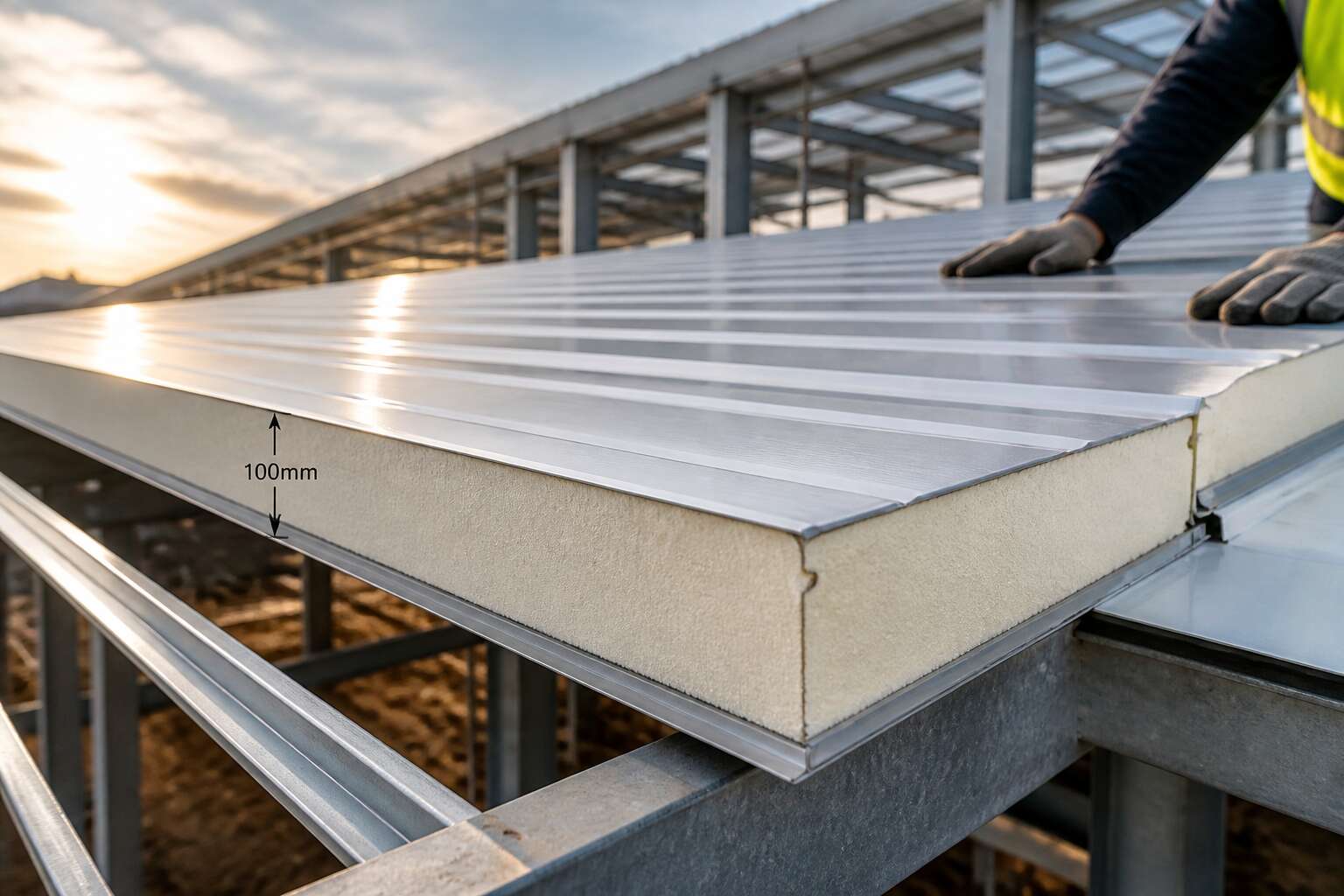
Thick insulated roof panels are engineered assemblies where every millimetre earns its place. The central core is the thermal heart, and its composition determines fire rating, compressive strength, and insulation value. I’ve specified these systems, and the core material always dictates the panel’s limitations.
- Expanded polystyrene (EPS) is light, cost effective, adequate for temperate climates.
- Polyurethane (PUR/PIR) offers superior insulation in a thinner profile, with better fire resistance.
- Mineral wool is non combustible and excellent for high fire risk zones.
Encasing this core are steel facings, galvanised or coated with polyester. These facings give the panel its rigidity and protect the core from moisture and mechanical wear. For those specifying 100mm insulated roof sheets, the configuration is a 100mm thick sandwich that balances thermal performance with structural demands. South African projects, from agricultural sheds to logistics hubs, rely on this depth to maintain internal temperatures without excessive energy use!
Common Types and Profiles
Roofs are the largest single surface in most industrial buildings, and they lose heat faster than any wall. That is why 100mm insulated roof sheets have become the default specification for cold storage facilities, manufacturing plants, and commercial warehouses across South Africa. These thick insulated roof panels are essentially a steel sandwich with a solid thermal core, and the outer profile determines how they behave in wind, rain, and under load.
The profile of the steel facing is not just a cosmetic choice. It dictates water runoff, structural span capability, and how the panels fix to the purlins. For a 100mm insulated roof sheet, the most common profiles you will encounter are:
– IBR, which sheds water rapidly and suits high rainfall regions like KwaZulu-Natal.
– Trapezoidal, offering a flatter appearance with greater load bearing capacity for wider spans.
– Corrugated, the classic sine wave shape, widely available and easier to repair.
Understanding these profiles matters because the same 100mm thickness performs differently depending on the facing shape. A trapezoidal profile might handle a 6 metre span, while an IBR profile needs closer support. Always cross check the manufacturer’s span tables against your actual roof pitch and expected wind uplift.
Thermal Performance Basics
A dark steel roof in Mpumalanga can hit surface temperatures above 70°C in summer, then radiate that heat into the building all night. A 100mm insulated roof sheet stops this cycle. It works as a thermal barrier, slowing heat flow in both directions. Performance is measured by R-value, the material’s resistance to heat transfer. The higher the R-value, the more stable the internal temperature.
Insulation performance depends on several factors:
- Core density and type, which determine how well heat is trapped.
- The integrity of the bond between the metal and the core.
- The reflectance of the steel facing, which repels radiant heat.
For 100mm insulated roof sheets, these factors combine to cut energy demand for cooling and heating. That makes them a practical choice for buildings where temperature control is non-negotiable.
Typical Sizes and Thickness Options
The thickness of a composite roof panel dictates weight, cost, thermal lag, and structural span. Thick insulated roof panels are built from two steel skins bonded to a rigid insulating core, and their depth, measured from outer face to inner face, is the primary specification. A 100mm insulated roof sheet occupies the middle of the available range, thinner than the 150mm slabs specified for cold storage, thicker than the 40mm economy panels that barely slow the Highveld sun.
Standard widths run to 1000mm or 1200mm, with lengths cut to order. South African suppliers commonly stock these core thicknesses:
- 50mm, light duty for sheds and outbuildings
- 75mm, a middle ground for smaller warehouses
- 100mm, the standard for commercial and industrial roofs
- 120mm and 150mm for extreme temperature control
Each additional millimetre of core adds weight and purchase cost, but also extends the distance heat must cross. The 100mm insulated roof sheets deliver the most practical balance for most buildings, slowing summer radiant gain and winter heat loss without demanding the deeper profiles’ extra structure.
Key Benefits for Modern Buildings
Superior Thermal Insulation
As electricity tariffs climb and summer heat waves intensify from Gauteng to the coast, the roof becomes the first line of defence. Superior thermal insulation is where 100mm insulated roof sheets transform the daily rhythm of a building.
The core benefit is a practical one. These panels slow heat movement so effectively that indoor temperatures stay stable through a scorching afternoon or a cold Highveld night. For a warehouse, that means less thermal stress on stored goods. For a home, it means bedrooms remain restful even at peak sun.
- Reduced peak heat gain during midday hours
- Shorter running cycles for cooling equipment
- More consistent comfort for occupants
This level of insulation, delivered by 100mm insulated roof sheets, also eases the strain on energy budgets, especially in commercial spaces where roof area is vast.
Acoustic Insulation and Noise Reduction
Noise is the uninvited guest that arrives without wine. In South Africa, the hum of backup generators, the barking of neighbourhood dogs, and the occasional taxi hooter make a quiet interior something to treasure. This is where acoustic insulation becomes a feature, not a footnote.
The dense composition of 100mm insulated roof sheets helps attenuate sound transmission. A hailstorm sounds less like a percussion performance. A commercial unit near a busy thoroughfare gains a measure of calm.
- Lower noise intrusion from outside sources
- Reduced echo inside large open areas
- More restful environments for occupants
No roof eliminates noise entirely. Yet 100mm insulated roof sheets reduce its reach. For homes and businesses alike, that makes quietness more attainable.
Condensation Control and Air Tightness
Condensation is a quiet saboteur. It creeps into roof cavities, soaking insulation, staining ceilings, and fostering mould that degrades indoor air. The 100mm insulated roof sheets counter this with a continuous thermal barrier. The insulating core keeps the underside temperature steady, preventing warm interior air from condensing against a cold roof surface.
Air tightness reinforces this defence. Small gaps and misaligned overlaps allow moisture-laden air to penetrate the building envelope. Properly installed 100mm insulated roof sheets minimise those pathways:
- Reduced moisture buildup inside the roof structure
- Lower risk of rust and timber degradation
- Consistent thermal performance throughout the year
Structural Strength and Durability
South African summers have a way of exposing weak roofs. Hail, wind, and heat test every material. The 100mm insulated roof sheets handle that test reliably. Their strength comes from a steel outer layer bonded to a dense foam core. That combination resists impact and keeps the structure rigid under heavy load.
Durability is not brute force alone. Corrosion and UV degradation silently shorten a roof’s life. Builders appreciate a roof that does not demand constant attention.
Consider these long-term benefits for any modern build:
- Predictable performance in extreme weather
- Reduced replacement costs
- Higher resale value for the building
These sheets form a stable envelope that stands up to the South African climate without drama.
Energy Cost Savings Over Time
Energy bills in South Africa climb year after year. Eskom tariffs have risen faster than inflation for over a decade. The 100mm insulated roof sheets offer a straightforward answer. Their dense foam core slows heat transfer dramatically, so air conditioners work less and run less often. The savings compound every month.
I have watched industrial clients in Gauteng cut their cooling loads dramatically after switching to insulated roofing. Uninsulated roofs lose cool air in summer and warmth in winter. These panels stop that thermal leakage from day one. In buildings where cooling dominates the load, electricity use can drop by a third or more. Those savings continue for the life of the roof.
The financial picture improves steadily:
- Lower monthly utility bills
- Reduced strain on HVAC equipment
- Better budget predictability
Installation Considerations and Best Practices
Pre-Installation Structural Checks
Pre-installation checks are where most roof failures begin. Before a single panel lifts, the substructure must prove its integrity. I have seen warped purlins and corroded fasteners doom an otherwise flawless build. For 100mm insulated roof sheets, the support spacing must match the manufacturer’s load table, not a guess. Verify the roof slope allows drainage, and inspect every fixing point for rust or fatigue.
Run this checklist before any installation begins:
- Confirm steel thickness and coating integrity
- Check that purlin spacing aligns with sheet span capacity
- Test for level and square across the entire frame
- Identify any obstructions like pipes or vents before laying
Your structure needs to handle the weight of these panels, plus wind uplift and thermal movement. A few minutes of measurement saves a decade of regret.
Tools and Equipment Required
One misaligned fixing can compromise an entire run of 100mm insulated roof sheets. Work from the bottom eave upward, and stagger the joints to keep the profile flat. A chalk line across the purlins keeps every row straight, and a sharp blade prevents the foam core from tearing.
The right tools make the job safer:
- A circular saw with a fine-tooth blade for clean cuts
- Self-drilling screws with EPDM washers for a watertight seal
- A rivet gun for edge flashings
- Lifting clamps to handle the panels without denting them
Keep the panels dry before installation, and stagger the sheet ends where possible. These panels expand in heat, so leave a small gap at the end caps. Fasten through the high ribs, not the flats, and torque the screws to the manufacturer’s setting. For 100mm insulated roof sheets, that final check separates a durable roof from a maintenance bill.
Step-by-Step Installation Process
Every 100mm insulated roof sheet has a designated fixing pattern, and ignoring it invites trouble. The manufacturer’s profile determines where the screws seat, typically on the crest of the rib. Placing them in the wrong zone creates stress points where water can pool and penetrate. The work demands patience, not speed.
The sequence matters as much as the placement. A proper installation follows a logical order.
1. Position the first sheet square with the eave, allowing a 50mm overhang.
2. Fix the sheet temporarily at the centre rib, then check the alignment.
3. Install permanent fasteners along the high ribs, working outward.
4. Overlap the next sheet by one full rib, ensuring the seam compresses evenly.
A common mistake is overtightening the screws, which crushes the EPDM washer and leaves the hole exposed. Another is leaving swarf on the surface, which rusts and stains the finish. In the South African climate, the sun’s UV exposure also affects how the panels expand and contract throughout the day. Roof sheets installed at midday may buckle overnight when the metal cools.
The gap at the ridge and eave is not a design flaw, it is a necessity. Sealing those ends rigidly transfers stress to the fixings. Allow the panels to move with the temperature shifts. For 100mm insulated roof sheets, the installation process is where the material’s value is proven. A roof that breathes correctly outperforms one that is locked down tight. The final inspection should verify the screw torque, the overlap alignment, and the condition of every washer. Each detail contributes to the structure’s long term integrity. Press on with methodical care. The result is a seam that remains watertight for decades, with zero margin for guesswork.
Flashing and Sealing Details
Flashing and sealing details determine the waterproofing integrity of 100mm insulated roof sheets. Transition points, valleys, hips, and pipe penetrations all demand flashings that accommodate thermal movement. South Africa’s UV intensity and temperature swings place unusual stress on these junctions.
The sealant choice matters. Neutral-cure silicone or butyl tape designed for metal roofing performs best. Polyurethane sealants can react with the coating over time, causing discolouration and bonding failure.
- Flashings need a 150mm upstand and 75mm coverage over the sheet profile
- Sealant bridges gaps without blocking drainage channels
- Pop rivets secure flashings instead of screws, preventing galvanic corrosion
Flashings must allow the sheets to move freely. Rigid connections tear under expansion. Seal the leading edge of the flashing overlap only, leaving the trailing edge unsealed for breathability. This simple detail prevents many failures and extends the service life of your 100mm insulated roof sheets.
Safety and Compliance Guidelines
In South Africa, the Occupational Health and Safety Act governs roof installations with particular strictness, and for good reason. Handling 100mm insulated roof sheets demands lifting and positioning techniques that plain metal sheeting does not. A panel several metres long moves unpredictably in our afternoon wind, so installers should stage weights on each sheet until every fastener is driven. I have watched experienced crews treat this step as non-negotiable.
Compliance extends beyond personal safety. Local building authorities expect proof that your 100mm insulated roof sheets satisfy SANS 10400 requirements for fire performance and structural resilience. Retaining certificates forms part of the building record, not an optional extra. The prudent contractor regards paperwork with the same seriousness as the roof itself.
- Schedule deliveries so panels stay covered and protected for less than one week
- Inspect every sheet for transit damage before it reaches the roof line
- Keep gloves and safety footwear on site at all times
Site behaviour reveals professional character. Crews that handle panels deliberately, keep the workspace orderly and show courtesy to the building’s occupants leave a reputation that serves them well at the next tender.
How to Choose the Right Insulated Roof Sheet
Assessing Your Roofing Requirements
According to a recent industry survey, over 60% of industrial roofing failures trace back to inadequate specification during planning. That statistic always stops me mid-step! Choosing the right cladding is about decoding your building’s physical demands. For 100mm insulated roof sheets, the assessment begins with the clear span between purlins. Your structural frame dictates the gauge and profile stiffness.
I always recommend mapping local environmental pressures before ordering. In South Africa, that means high ultraviolet exposure on the Highveld and salt laden air along the coast. You should also evaluate the internal environment. A warehouse storing temperature sensitive goods needs a different density than a workshop.
Your specific audit should cover:
- Roof pitch and drainage path efficiency
- Dead loads from suspended services or solar arrays
- Potential for hail impact in your region
Verified, the specification becomes intuitive. The final decision hinges on weight, thermal bridging, and condensation risk. Ignoring these variables causes costly retrofits.
Comparing Thickness Options
Once your assessment is complete, thickness selection comes down to arithmetic. A thinner core forces tighter purlin spacing, raising steel costs and erection time. 100mm insulated roof sheets carry standard bay widths without demanding a heavier frame, which keeps the structural budget in check.
I frequently line up three comparisons for clients weighing options:
- How the panel’s mass affects existing columns during seismic or wind events
- Whether the core’s compression strength matches point loads from maintenance foot traffic
- How the panel locks into flashings at ridges and eaves for your specific roof pitch
The 75mm profile works for seasonal structures, but year-round operations see compounding energy losses. 100mm insulated roof sheets typically recover the extra investment within a few cooling seasons, and that calculation holds up on the Highveld and the coast alike.
Understanding Insulation Core Types
The core is the quiet engine of any composite panel. For 100mm insulated roof sheets, the choice of insulation core determines how the panel answers fire, moisture, and temperature demands. A polyurethane core offers high thermal efficiency at a lower price point. Polyisocyanurate, or PIR, improves fire resistance and dimensional stability under heat. Mineral wool cores sacrifice some insulation value for superior fire integrity.
Consider the building’s exposure and function before selecting. The Highveld’s hail and UV load differs from coastal humidity. The core must match those realities.
- Assess the required fire rating for the structure
- Check humidity levels in the installation region
- Confirm the core’s compatibility with your flashing profile
These factors narrow the field quickly. When the core is right, 100mm insulated roof sheets deliver predictable performance for decades.
Standards and Building Regulations
South Africa’s National Building Regulations, SANS 10400, hold the final word on what a roof may and may not do. For 100mm insulated roof sheets, fire safety and weatherproofing carry the most weight. Yet the national rules are not the end of the conversation. Municipal by-laws often impose stricter demands, particularly for industrial or high-density areas.
The practical question is whether the panel’s test certificates match the required standard. For 100mm insulated roof sheets, a fire resistance report means nothing if it fails to mention the exact profile you are installing. Wind load calculations, likewise, need to reflect the region.
Here is where projects regularly stall:
- Check that the SANS approval covers the full panel system, including fixings.
- Confirm that the fire rating certificate names the specific insulation core.
- Ask whether the flashing profile is part of the certified assembly.
Regulations exist to prevent the same mistakes from being repeated. Choose a panel whose paperwork matches its performance, and the building inspector becomes an ally rather than an adversary.
Cost and Supplier Considerations
The cost of 100mm insulated roof sheets extends beyond the initial quote. Suppliers who undercut market rates often compensate with thinner steel gauge or unspecified insulation density. A credible quote itemises the profile, core material, and finish separately.
When evaluating suppliers in South Africa, verify their stock availability and lead times. Imported panels sometimes carry lower price tags but arrive with damage that voids warranty coverage.
- Request a certificate of origin for the steel coil.
- Ask whether the supplier manufactures locally or only distributes.
- Confirm the warranty terms in writing.
Beware of price-per-metre comparisons that ignore flashing, closures, and delivery costs. The cheapest 100mm insulated roof sheets become expensive when hidden charges surface after ordering. A supplier’s responsiveness to technical questions often predicts their after-sales behaviour.
Long-Term Maintenance and Performance
Regular Inspection Routines
South African weather tests every roof. Ultraviolet radiation, hail, and coastal salt apply slow pressure to the 100mm insulated roof sheets. I have seen well-sealed installations outlast their neighbours simply because someone walked on the roof twice a year.
Regular inspection routines should cover these areas:
– Verify fastener torque and rubber washers for cracks
– Inspect end laps and side laps for gap formation
– Clear debris from valley gutters and roof drains
– Check sealant beads around flashings and penetrations
Your eyes catch what instruments miss. Hairline fractures around screw heads often precede leaks. I recommend scheduling checks after the summer storm season and again before winter rains for 100mm insulated roof sheets. A thermometer or moisture meter helps identify wet insulation beneath the surface. Record every finding. Those notes become your earliest warning system.
Cleaning and Surface Care
Longevity of 100mm insulated roof sheets depends on how the surface is treated through the years. The painted finish, often a PVDF or polyester coating, collects dust, pollen, and salt spray. Rain rinses some of it, but dry seasons leave a film that can dull the surface and hold moisture against the coating.
Cleaning should be deliberate. Use a soft cloth or a brush with synthetic bristles and plain water. For stubborn grime, a mild detergent works, but avoid solvents and high pressure washers. The latter can force water past the lap joints and into the insulation core.
I have seen roofs where the only damage was caused by someone scrubbing too hard. Surface care is less about effort and more about regularity. A gentle rinse twice a year preserves the gloss and the reflective properties that keep buildings cool.
Repairing Damage and Impact
100mm insulated roof sheets are stout, yet they harbour a secret fragility. Impact damage often arrives without warning. A hailstorm drives pellets into the metal skin, or a maintenance worker steps on an unsupported bay. The result is a dent or puncture that breaks the protective coating and exposes the core.
- Punctures from falling tools or sharp debris
- Creased panels from improper walking paths
- Corrosion around fasteners where the coating fails
Repairing damage quickly prevents the insulation core from absorbing moisture. Use a patching compound compatible with the original paint system. For larger breaches, replace the entire sheet to maintain structural integrity. Neglect turns a small wound into a costly performance failure. The 100mm insulated roof sheets forgive minor abuse, but they never forget.
Expected Lifespan and Warranties
The true measure of a roof lies in its third decade, not its first season. In South Africa, 100mm insulated roof sheets commonly serve 30 to 40 years when maintained with annual inspections. Coastal salt air and heavy UV exposure accelerate wear on the outer skin, so attention matters.
Warranties generally span 10 to 20 years. They cover paint systems and core integrity, but only if the installer used approved fixings.
– Paint warranty: 10 to 15 years
– Core warranty: 20 years against delamination
– Steel warranty: dependent on coating class
For 100mm insulated roof sheets, the warranty paperwork holds the same weight as the steel itself. Keep it safe.

0 Comments