Choosing the Right Roof Sheet Length
Why Sheet Length Affects Installation Ease
Roof sheet length dictates how easily a crew can move material across a frame. Roof sheets 2.5m offer the best compromise for most South African residential projects. In our experience, a typical sheet in this length weighs between 10 and 12 kilograms, which two workers can lift and position without lifting gear.
Installation ease changes as length grows. The primary factors that shift are:
- The number of end laps and leak points
- The weight each worker carries
- The fasteners needed per sheet
A longer sheet reduces laps but adds weight. A shorter sheet is lighter but multiplies seams. The 2.5m length balances those pressures for most roof layouts.
Common Standard Sizes and Their Applications
Choosing the right roof sheet length starts with measuring your roof span and checking the pitch. Roof sheets 2.5m handle most residential profiles, including IBR and corrugated options. Smaller projects, such as a garden shed or a chicken coop, rarely need anything beyond a 1.8m sheet. Larger commercial structures often jump straight to 3m or longer to cut down on the number of sheets ordered.
Standard sizes used in South Africa include:
– 1.8m for small structures and boundary walls
– 2.1m for carports and verandas
– 2.5m for typical house roofs
– 3.0m plus for warehouses and industrial buildings
A builder will often choose roof sheets 2.5m when the roof span sits between 5 and 7 metres, since two sheets per slope line up neatly with common truss spacing. That makes ordering simple and leaves fewer offcuts behind, which is a small victory on any job site.
How to Measure Your Roof for a Two-Point-Five-Metre Panel
Roofing suppliers across South Africa report that measurement errors cause more returns than any other issue. A misplaced decimal or a forgotten overhang turns a perfect fit into a costly delay.
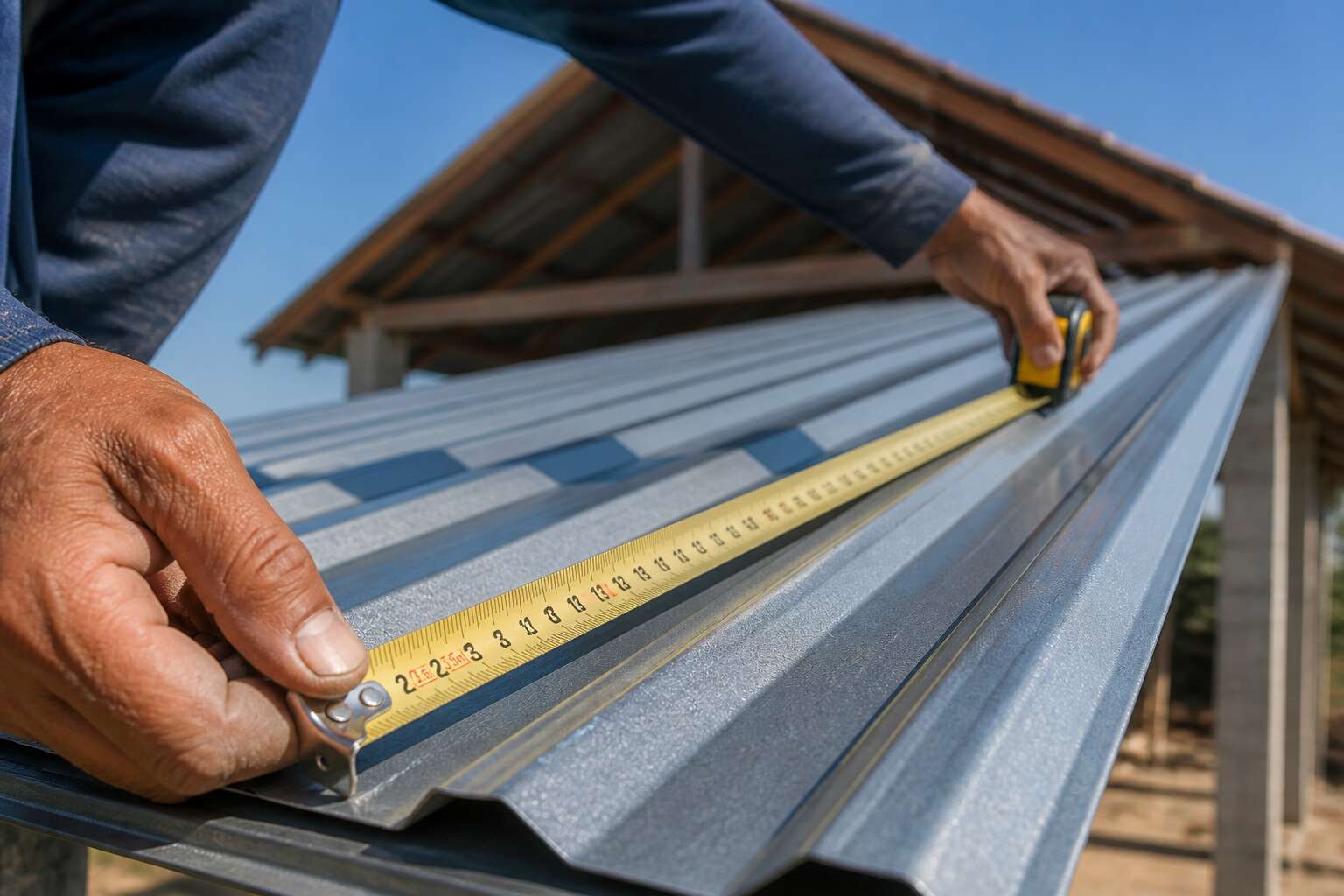
Measuring for roof sheets 2.5m means working with the rafter length, not the building width. Run your tape from the outer edge of the eave to the centre of the ridge, then add the required overhang on both ends. The pitch angle extends this distance, so a 5 metre roof span often produces a true rafter length just beyond 2.5 metres. That is why builders confirm the measurement on site before ordering.
Keep these checks in mind while measuring:
- Account for the gutter depth; the sheet should overhang it by at least 50mm
- Verify the batten spacing so the sheet profile lines up with the purlins
- Add an allowance for ridge capping overlap where two slopes meet
Roof sheets 2.5m deliver a clean fit when the measured rafter length falls just under that mark, allowing for trim offcuts without compromising the profile.
Material and Profile Options for Medium-Length Panels
Corrugated versus Box Profile Designs
Profile selection often matters more than the metal gauge. Corrugated sheets shed water with ease and can follow curved surfaces. Box profile sheets offer flat surfaces with concealed fasteners, giving a home a modern and secure appearance. When you order roof sheets 2.5m, you gain the flexibility to choose either style without extra cost. I have learned that corrugated handles minor impact better, while box profile resists strong wind uplift. Consider the differences:
- Corrugated: classic, flexible, cheaper to transport.
- Box profile: sleek, rigid, fewer visible screws.
Both perform well on South African roofs. The key is to match the profile to your architectural vision. For roof sheets 2.5m, the compact size makes handling manageable, so do not shy away from either option! Ensure the base metal thickness suits your area’s hail or wind codes.
Metal, Plastic, and Fibre Cement Materials
The material you choose for your roof sheets 2.5m decides how the sun, rain, and wind treat your home. Metal remains the default choice in South Africa for its fire resistance and longevity. Plastic panels offer a translucent option for carports and patios where natural light is welcome. Fibre cement brings a dense, quiet surface that dulls hailstones and reduces noise. These materials behave differently in the same climate.
Consider these points before you commit:
- Metal reflects heat well but expands and contracts loudly without proper fastening.
- Plastic is light and easy to cut, but it scratches and yellows with age.
- Fibre cement holds paint longer and ignores rust entirely.
With roof sheets 2.5m, the compact span minimises waste and keeps transport costs low, while the substrate determines the true lifecycle. Match the material to the exposure and the budget.
Protective Coatings and Weather Resistance
Coastal salt spray can corrode an uncoated steel panel in under two years. That is why the protective coating on your roof sheets 2.5m deserves as much scrutiny as the profile shape itself. Medium-length panels carry the same surface area per square metre as longer runs, so the coating must absorb identical UV, moisture, and thermal stress.
The substrate only survives when the coating matches the local exposure. A zinc-aluminium alloy layer with 55% aluminium content resists salt attack better than standard galvanising. PVDF paint systems hold their colour under high UV load, while plastisol films cope with chemically aggressive industrial air.
For roof sheets 2.5m, consider which coatings suit your conditions:
- Zinc-aluminium alloy for coastal suburbs.
- PVDF topcoats for interior Highveld sun.
- Plastisol for factory zones with airborne chemicals.
Profile depth also dictates drainage. Deeper corrugations shed heavy summer downpours quickly, whereas low-profile box sections trap less leaf litter and dry faster after thunderstorms.
Colour Choices and Their Impact on Roof Aesthetics
A dark roof in Mpumalanga can reach 70°C on a clear January afternoon, which is why colour choices shape how roof sheets 2.5m perform long before aesthetics enter the conversation. Lighter hues bounce solar gain, reducing thermal movement in the panel profile. Darker tones suit cold regions but accelerate the fatigue on sealants and fasteners.
Profile selection follows the math of medium spans. A 2.5m length locks into rafter spacing without the droop seen on longer lightweight panels, so you can confidently opt for a low-profile rib. Consider these options:
- IBR roofing, for efficient drainage and broad rafter coverage.
- Box profile, for a clean modern facade.
- Corrugated, for traditional farmstead ambience.
Every pattern changes the rhythm of shadows across the elevation, giving the home its own visual tempo.
Installation Guide for Standard-Size Roof Sheets
Preparing the Roof Substructure
The substructure is the quiet skeleton beneath every roof. I have seen roof sheets 2.5m laid over frames that sagged, and the panels never fully settled. Before a single sheet is lifted, the purlins demand inspection:
- Run a taut string line along each support to expose the dips the eye forgives.
- Probe timber for rot and steel for rust, especially around old fasteners.
Spacing decides whether the roof endures. For corrugated profiles, set supports around 900mm apart. Box profile designs need tighter intervals, and the manufacturer’s guidance is the only reliable reference. The screw bites only as deep as the material behind it allows. A compromised batten surrenders that grip during the first heavy storm, and the roof sheets 2.5m work loose, one seasonal swell at a time.
Fastening Methods and Screw Placement
The screw grip turns a sheet into a roof. With roof sheets 2.5m, the lap between neighbouring panels is the weakest seam. The self-tapping fastener must enter the crest of the corrugation at a true 90 degrees; a tilted point tears the steel and leaves a wound for water to find.
Neoprene washers should compress into a thin collar, not a crushed mess. I run a low-speed driver with a torque stop so every fixing seats the same.
For a standard installation, I follow this sequence:
- Fix the eave sheet first, screwing down the near side.
- Work across the roof, each sheet overlapping one full rib.
- Confirm every screw bites at least two purlins on a 2.5m span.
The screw pitch at the sheet ends is 150mm, and 200mm along the internal supports. With steady hands, the roof sheets 2.5m settle into a quiet, locked line.
Overlap and Sealing Techniques for Water Tightness
The overlap is where water tests the workmanship. On roof sheets 2.5m, a single full rib lap is standard, but the lap alone does nothing. The seam needs a controlled squeeze of sealant, not a careless smear. Butyl tape pressed into the underside of the high rib compresses into a clean, unbroken line.
Sealing techniques follow a steady order:
- Clean the overlapping surfaces, removing all swarf and dust.
- Lay a continuous butyl strip along the crown of the lower sheet.
- Set the upper sheet and clamp, letting the rib close around the tape.
Closure strips at the eave and ridge stop birds, debris, and driven rain. Foam strips, cut with the profile, sit before the sheets are fixed. The roof sheets 2.5m demand that every seam remain sealed against the weather.
Cutting and Adjusting Panels on Site
Measure twice, cut once. That old roofer’s adage carries real weight when a shearing disc is in your hand and a 2.5m panel is on the cutting table. While the factory edges are true, site adjustments are often unavoidable. A gable end that’s out of square or a valley that needs a custom fit will demand a precise trim. Using a power shear or a fine-tooth circular saw with a carbide blade will produce a clean edge, avoiding the heat discolouration that an angle grinder often leaves behind.
Accuracy here prevents frustration later. Mark your cut line with a straightedge and a felt-tip pen, aiming for a deviation of no more than 3 millimetres across the sheet. The material’s tensile strength makes it unforgiving to sloppy work. After cutting, always deburr the edge with a file, as sharp swarf can slice through gloves and skin with surprising ease.
Site adjustment also covers the practicalities of fixing:
– Use a timber batten as a straight edge when marking longitudinal cuts.
– Support the sheet evenly to prevent it from buckling under its own weight during trimming.
– Pre-drill holes for screws when working near the edge of the profile to avoid distortion.
The weather is a factor. Working in the Highveld’s afternoon wind, a 2.5m sheet can act like a sail. Secure it quickly after positioning, but do not over-tighten the fasteners. The slight thermal movement of the metal needs room to breathe. A sheet that is forced into place will buckle over the seasons. Patience, a sharp blade, and a steady hand turn a standard-sized panel into a tailored piece of the puzzle, even when the structure throws a curveball.
Essential Safety Equipment and Working at Height Practices
Falls from height rank among the top causes of construction fatalities in South Africa. Lifting roof sheets 2.5m onto a roof frame demands a steady footing as the panel catches the Highveld wind. Two people can manage these standard-size sheets, but the height adds a risk that demands methodical work.
The essential safety equipment list is short, but it is non-negotiable!
- A full-body harness and double lanyard, clipped to a certified anchor before stepping onto the roof
- Rubber-soled boots with tread that grips the corrugated profile
- A tool lanyard to keep screw guns off anyone below
We treat working at height as an exercise in planning. Position the roof sheets 2.5m above their fixing points before shifting weight along the purlins. The short span means fewer fasteners than longer profiles, so alignment errors compound quickly. Check the scaffold, clip the lanyard, and trust your equipment. A fall at this height is fatal.
Buying Considerations and Cost Factors for 2.5-Metre Cladding
Where to Purchase Quality Roofing Sheets
Price per metre rarely tells the whole story. In South Africa, the cost of roof sheets 2.5m can swing by 15% or more between suppliers for identical gauge and profile. That variance stems from steel coil sourcing, transport distances, and stock turnover rates!
Compare delivered cost, not sheet price alone. A supplier in Gauteng may quote lower unit pricing, but freight to the coast could erase that advantage. The supplier may hold roof sheets 2.5m in stock or cut to order. Cut-to-order items often mean shorter lead times, yet they carry waste charges.
- Confirm the minimum order quantity
- Request pallet-level bulk pricing
- Verify coating warranty terms
Builders Warehouse and Cashbuild stock standard profiles, while specialist metal merchants often undercut their prices. I have found local manufacturers near Vereeniging, Durban, and Cape Town supply directly, sometimes including delivery. Coating certificates and sample swatches are standard practice for reputable suppliers.
Expected Price Ranges and Budgeting Tips
Pricing for roof sheets 2.5m in South Africa fluctuates with steel input costs. I have seen a 15% variance between regions for identical gauge. Transport adds weight to the final figure. A cheaper unit price from a distant supplier often costs more once delivered. The gauge thickness affects the price more than the profile does. A 0.5mm sheet costs less than 0.6mm. That difference impacts longevity. Budget for fasteners, flashing, and sealant. These ancillary items consume an extra 10% of the total. Consider the hidden costs:
– Coating type (chromadek versus PVC plastisol)
– Ridge capping and bargeboards
– Waste allowance of 5% to 10% for cuts
Quotes from three suppliers in the same province will reveal the actual spread. Payment terms and minimum order quantities shift the effective price per sheet.
Delivery, Storage, and Handling Guidelines
Buying roof sheets 2.5m goes beyond comparing unit prices. A quote without a confirmed delivery date is only half a promise. Check the batch number across bundles, since colour shifts happen between production runs. That matters when panels sit side by side on one slope.
Once roof sheets 2.5m arrive, storage becomes the test. Stack them on a level base, tilted to let water run off. Never leave them on wet ground or wrapped tight in plastic overnight, condensation stains the coating. Wear gloves; skin oils leave marks under certain light. Lift panels vertically, never drag them, because edge scratches invite corrosion and a scrap sheet costs more than the delivery fee.
Before the truck arrives, I confirm a few details:
- Measure gate widths and turning circles for the vehicle.
- Ask whether a tailgate lift or crane offload is included.
- Book a morning slot so offloading happens before the wind picks up.
Warranties and Guarantees to Look For
Buying roof sheets 2.5m means weighing upfront price against long term performance. The steel gauge and coating thickness drive most of the cost difference. A supplier who quotes the lowest number may be using a thinner substrate, and that compromise shows up as premature rust. I always request a written specification before negotiating.
Warranties need equal scrutiny. Look for:
1. A clear term of coverage, ideally ten years for corrosion.
2. Transferability if you sell the property.
3. Conditions around coastal or high humidity zones.
Many South African manufacturers treat the warranty as a coating promise, not a panel guarantee. That distinction matters when a scratch exposes the steel. Ask whether the warranty covers replacement or only repair. roof sheets 2.5m with a confirmed coating warranty still require correct installation, because most claims fail on improper fastening.
Maintenance and Durability Tips for Roofing Panels
Routine Inspection and Cleaning Schedules
Roof sheets 2.5m in length still face the same threats as longer panels: grime, trapped moisture, and slow corrosion under forgotten sealant beads. A roof that looks fine from the ground can hide trouble in its valleys and overlaps.
Routine inspection should happen twice a year, ideally after winter storms and before summer heat. Walk the roof only when dry, and pay close attention to fastener heads, flashings, and the laps between sheets. Buildup of leaves or dirt holds water against the surface, which accelerates wear. For gentle cleaning, use a soft brush and water; avoid pressure washers that force moisture into joints.
- Check for lifted screws and re-seat them immediately.
- Clear debris from gutters and panel channels.
- Look for rust spots near cut edges.
Catching small faults early extends the life of any roof sheets 2.5m installation by years. A ten minute inspection is cheaper than a leak.
Preventing and Treating Rust and Corrosion
Rust on roof sheets 2.5m rarely announces itself loudly. It begins as an orange bloom near a cut edge or a scratched fastener hole, then creeps under the protective layer where moisture lingers. Galvanic corrosion is the culprit; once the sacrificial zinc is breached, ferrous oxide spreads through the substrate.
I have seen panels fail because the underside was ignored. Condensation forms there in winter. Scrapes and drill burrs need immediate treatment. Sand to bright metal, apply a zinc rich primer, and seal penetrations with a compatible mastic.
Corrosion hotspots tend to follow predictable patterns:
- Guillotine cut edges left bare
- Areas beneath leaf debris in valleys
- Overlaps where the sealant bead failed
Coastal South African air accelerates corrosion. Roof sheets 2.5m installed near the ocean deserve quarterly inspections rather than the standard twice yearly check. The salt mist settles into every lap and fastener hole, so catch it early!
Knowing When to Repair or Replace Your Roof Sheets
Maintenance is the quiet art of extending a panel’s service life. Roof sheets 2.5m endure highveld storms and coastal salt without complaint, yet the first signs of wear always arrive in the details. Clogged valleys allow water to pool against the laps, and pooled water slowly undermines the protective film.
Durability is not a function of gauge alone. It depends on how swiftly you notice the small failures. Washer splits, popped fasteners, and rippling edges all reveal structural strain. Once moisture reaches the core, the sheet loses its load bearing character.
- Deep scratches exposing bright metal
- Buckling along end laps
- Water staining on purlins beneath the deck
Repair remains sensible while the panel stays flat and rigid. Replacement becomes unavoidable when the sheet has lost its shape or the coating has lifted. The cost of patience only appears when you settle the final invoice.



0 Comments