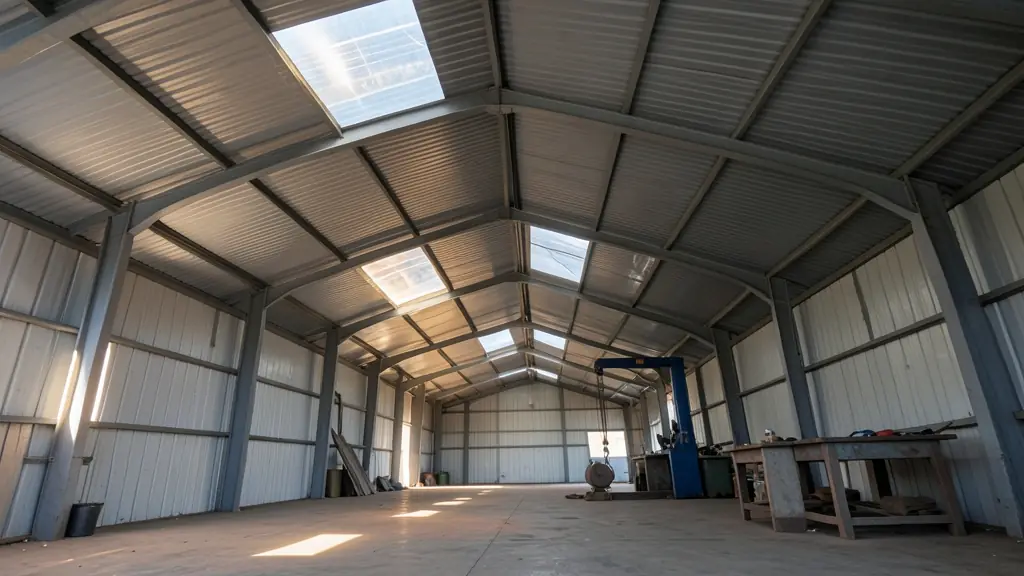
A few clear roof sheets in a steel roof turn a dark workshop, store or garage into a place you can work in without the lights on all day. They are see through or translucent sheets made in the same profile as the steel, so they lap in where a steel sheet would be. A mechanic in Germiston, a hardware store in Polokwane and a dairy near Bethlehem all ask the same things: which sheet, how many, where to put them, and how to stop someone falling through one.
Match the profile exactly
The clear sheet must have the same rib spacing, rib height and cover as the steel around it, or the side laps gape and leak. IBR from one roll former is not always the same shape as IBR from another, and old corrugated may differ from new. Take an offcut or a clear photo of the rib with a tape measure across it to the supplier. Order the clear sheet as long as the steel sheets so there is no end lap in the middle of the slope.
Polycarbonate or fibreglass
- Polycarbonate is the clearest and toughest in hail. Mind the UV side and the oversized holes. See polycarbonate roof sheets.
- Fibreglass gives a softer, diffused light, copes with acid and salt air better, and is often chosen for chemical plants and animal sheds. See fibreglass roof sheets.
- PVC is the cheapest and the shortest lived; it is not ideal in a working roof.
How many and where
A common starting point is about one clear sheet in every eight to ten, spread evenly along both slopes rather than bunched at one end, so light falls across the whole floor. Keep them away from the ridge and eaves flashings, where the fixing is busiest, and out of the line of afternoon sun over a desk or a parked car. Over a bench where people work, opal or fibreglass is kinder than clear. Count the sheets across the roof with the roof sheet calculator first.
Falls, sealing and old yellow sheets
Clear sheets will not carry a person. Falls through them cause serious injuries every year, so never step on one, mark them for anyone working up there, and on some buildings fit safety mesh under them. Seal the side laps with the profile's tape or sealant and fix every crest at each purlin. Old sheets that have gone yellow and brittle let in little light and crack when touched: replace them with a new sheet matched to the profile, not a patch.
What to put in your request
- Send a photo of the rib shape with a tape on it
- Give the length of the steel sheets
- Say how many clear sheets and where
- Mention chemicals, animals or salt air
- Ask whether safety mesh is advised
Clear Roof Sheets: who asks for them and why
- Homeowners and DIY builders: a few clear sheets in a garage or outbuilding roof so the lights can stay off
- Roofers and roofing contractors: daylight sheets matched to the client's steel profile and lapped in with sealed sides
- Builders, developers and quantity surveyors: clear sheets specified along new warehouse and workshop roofs at even spacing
- Factories, warehouses and steel buildings: factory and warehouse roofs that need daylight across the floor during working hours
- Shops, offices and business premises: hardware stores, car washes and showrooms that want natural light under a steel roof
- Farms: sheds, barns and animal houses: dairy, stable and implement shed roofs with translucent sheets for daylight
- Schools, churches, clinics and halls: school halls and municipal depots with tired yellow sheets due for replacement
- Landlords, body corporates and estate managers: storerooms and parking covers in a complex lit by a few clear sheets
Frequently asked questions
Will clear sheets make the workshop hot?
Can I add clear sheets to an existing roof?
Are see through and transparent roof sheets the same thing?
Who will quote for clear sheets?
Work it out first
- Roof sheet calculatorEave length, slope and profile in, sheets, cut lengths and running metres out
- Roof pitch and area calculatorFootprint and pitch, or rise and run, in: slope length, sloped area and pitch out
- Purlin spacing calculatorProfile, thickness and roof or wall in: the typical span to check and purlins per slope