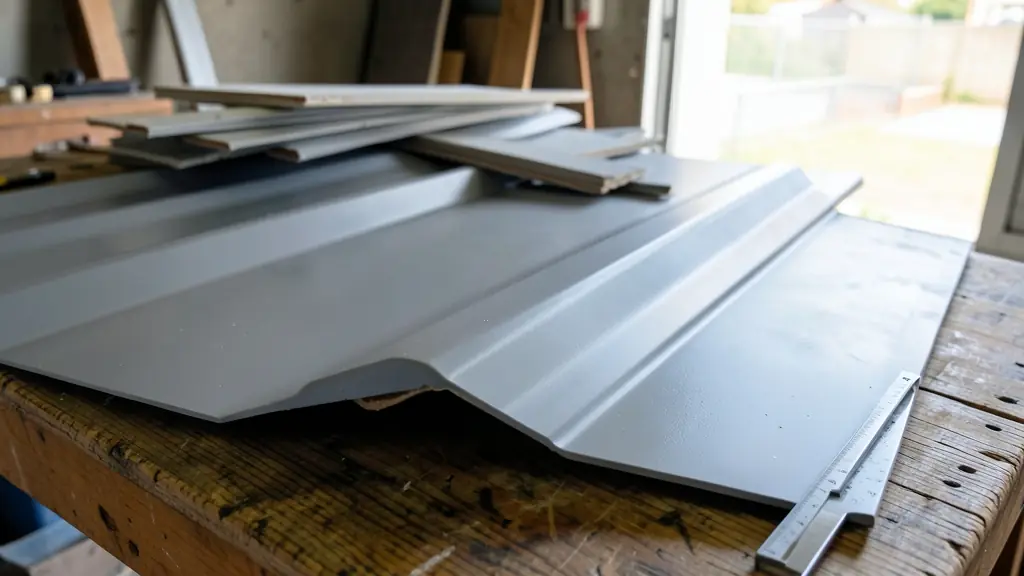
IBR roof sheets thickness, or gauge, is the single number that most changes how a sheet behaves: whether it dents in a Pretoria hailstorm, how far it spans between purlins, and whether a solar installer can walk on it. Common steel sheets run from about 0.4 to 0.6 mm, with 0.47 and 0.5 mm the usual house roof. A few tenths of a millimetre sound like nothing, yet a 0.5 mm sheet holds about a quarter more steel than a 0.4 mm one.
Base metal or total coated thickness
A docket can show two figures. BMT, base metal thickness, is the steel alone. TCT, total coated thickness, adds the zinc or aluminium zinc coating and any paint, so it reads higher. A sheet sold as "0.5" may be 0.5 mm TCT, which is thinner steel than 0.5 mm BMT. Ask which one the quote means, and get it written on the docket.
Thin sheets: cheap for a reason
Sheets of 0.3 mm and under are sold at low prices in yards and on the roadside. They dent under a ladder, a footstep or a hailstone the size of a marble, the screws pull through in wind, and the thin coating rusts early. They suit a chicken coop, not a bedroom. Some carry a printed "0.5" that a micrometer proves false, and a few yards stack them beside proper sheets at a price that looks like a bargain. Press a thumb into the pan of a sheet before you buy: a thin one flexes and pops back with a tin can sound.
Thickness, spans and foot traffic
The data sheet lists a maximum purlin spacing for each thickness, and the figure falls as the steel gets thinner. Swapping 0.5 mm for 0.4 mm on a roof designed for 0.5 mm leaves the purlins too far apart. Check yours on the purlin spacing calculator and confirm with the data sheet. Roofs that people will walk on for solar panels, geysers or gutter cleaning are better at 0.5 mm or more; the weight calculator shows what the extra steel adds to the trusses.
How to check a sheet
- Read the mark many mills print on the underside: thickness, coating class and a batch code.
- Measure a cut edge with a micrometer, not a tape, away from the paint on the top.
- Match both against the docket before the truck leaves.
For the profile itself see IBR roof sheets; for coatings see galvanised.
What to put in your request
- Name the thickness the plans or roofer ask for
- Ask whether the figure is BMT or TCT
- Give the purlin spacing if you know it
- Say if solar panels or foot traffic are planned
- Mention hail damage on the old roof
Roof Sheet Thickness: who asks for them and why
- Homeowners and DIY builders: choosing between 0.4 and 0.5 mm for a new roof that has to survive hail
- Roofers and roofing contractors: thickness confirmed on the docket before fixing, and thinner sheets refused on site
- Builders, developers and quantity surveyors: the thickness on the plans matched to the purlin spacing the truss designer set
- Factories, warehouses and steel buildings: heavier sheets on roofs walked by maintenance crews and around plant and ducts
- Shops, offices and business premises: roofs under solar arrays where installers walk the sheets during fitting and service
- Farms: sheds, barns and animal houses: lighter sheets for small sheds and heavier ones for wide span barns in hail country
- Schools, churches, clinics and halls: school and clinic roofs reroofed in a gauge that takes contractors walking on it
- Landlords, body corporates and estate managers: one thickness specified for all units so hail claims and repairs stay simple