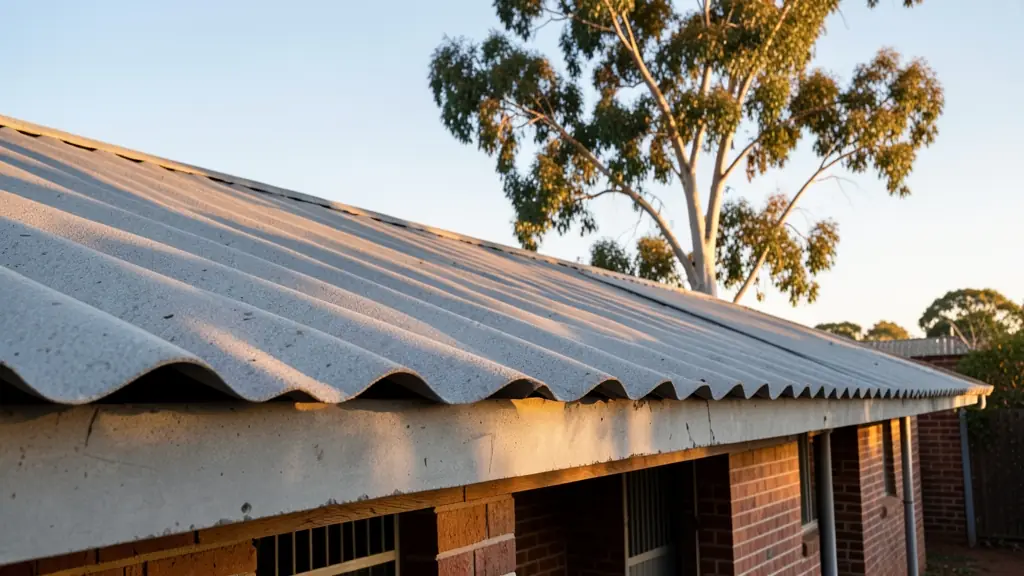
Fibre cement roof sheets sold today are made of cement, sand and cellulose or synthetic fibres, with no asbestos in them. The deep corrugations carry rain off a wide sheet, the roof does not rust, and it stays quiet in a Highveld downpour where a steel roof drums. That is why you find them on schools, church halls, farm sheds and old mine houses across the country. The trade off is weight and brittleness: they need careful handling, the right laps and nobody walking on them.
The profiles you will be offered
The one most people ask for is the large six corrugation profile, the deep wide sheet on many farm sheds and halls, often searched for as "big six roofing sheets". There are also smaller, shallower corrugated profiles for lighter roofs, outbuildings and walls. Each sheet is wider than a steel sheet, so you need fewer across a slope. Ask the supplier for the cover width of the exact profile, because the full width and the cover differ, and sheets from different makers may not nest together on a repair.
Set lengths, laps and mitred corners
Fibre cement is not cut to the centimetre at a factory: it comes in a range of set lengths, and long slopes are made up of two or more sheets with an end lap. Where four sheets meet, two of the corners are cut off at an angle (mitred) so only three layers sit on top of each other and the sheets lie flat. Skip the mitres and the corners crack or lift. See roof sheet sizes for working out lengths, and roof flashings for the ridge and barge pieces.
Weight, fixing and crawl boards
A fibre cement roof is much heavier than steel, so the trusses or purlins must be designed for it; the roof sheet weight calculator gives a rough total. Holes are drilled, never punched, and the fixing goes through the crest with the bolt or screw and washer the data sheet names. The sheets are brittle, and a foot between purlins can go straight through. Roofers lay crawl boards or ladders across the purlins and work from those.
Old sheet or new sheet?
Grey corrugated cement sheets on a roof built before 2008 may contain asbestos, and a new sheet and an old one can look the same. Only a lab can tell, from a piece a competent person removes safely. Do not break off a piece to check. Read asbestos roof sheets before touching an older roof.
What to put in your request
- Say which profile you need, large or small
- Give the slope length and the length along the eaves
- Mention if the trusses are steel or timber
- Say if old sheets must come off first
- Ask for ridges, barge pieces and fixings listed
Fibre Cement Roof Sheets: who asks for them and why
- Homeowners and DIY builders: a quiet, rust free roof on a farmhouse, a cottage or an outside room
- Roofers and roofing contractors: replacing cracked sheets on halls and sheds, with mitres cut and crawl boards down
- Builders, developers and quantity surveyors: school blocks, clinics and low cost housing where the plans call for cement sheets
- Factories, warehouses and steel buildings: roofs and wall cladding over plant where condensation and drumming rain are a problem
- Shops, offices and business premises: workshops, nurseries and farm stalls that want a plain roof with no rust
- Farms: sheds, barns and animal houses: implement sheds, dairies, stables and tobacco barns on the Highveld and in the Free State
- Schools, churches, clinics and halls: classrooms, church halls and community centres where rain noise must stay low
- Landlords, body corporates and estate managers: matching original fibre cement roofs on older complexes and mine villages