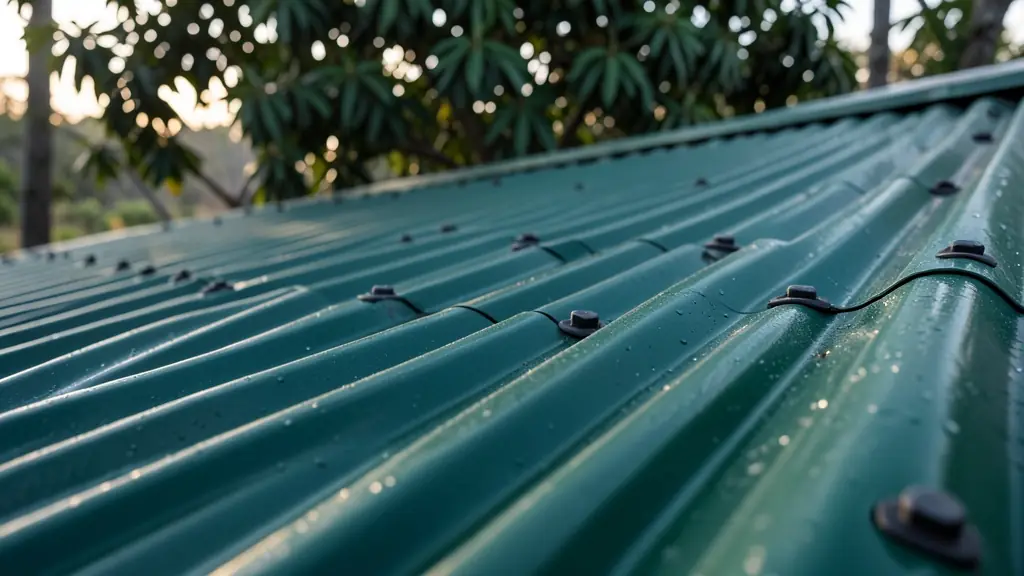
Roofing screws hold a sheet roof down against the wind, and on a South African roof they are nearly always self drilling screws with a sealing washer under the head. One screw drills its hole, forms its thread and pulls the sheet down onto the purlin in a few seconds. It has to suit the purlin, steel or timber, reach through the rib with enough thread left to grip, and carry a washer that seals without being crushed. Get those three right and most roofs stay dry and stay on.
Steel purlins or timber: two different screws
A screw for steel purlins has a drill point made for a range of steel thicknesses: one meant for light top hat sections may burn out on a thick hot rolled purlin in a warehouse, so tell the supplier what the steel is. A screw for timber has a sharp point and a coarser thread that bites into SA pine battens or trusses. Use the wrong one and it either spins without cutting into the steel or strips the wood and pulls out in the first big gust.
Length, washer and head colour
On IBR and corrugated the screw goes through the crest of the rib, not the pan, so water runs away from the hole. The screw must pass the full rib height and still bury its thread in the purlin; one that only just reaches holds by a couple of threads and works loose. The washer is usually a rubber seal bonded to a steel cup. Drive the screw square and stop when the rubber just starts to spread at the edge: squashed flat and split, it leaks; left loose, it lets water in. Heads come painted to match the common sheet colours, so a charcoal roof does not end up covered in silver dots.
How many screws, and where more go
The maker's data sheet gives the fixing pattern for each profile, thickness and wind exposure, so follow it rather than a habit. Across the middle of a roof, screws go at every purlin in a set pattern of ribs; at the eaves, the ridge, the gable edges and the end laps there are more, because that is where wind pulls hardest. Side laps on long spans get stitching screws, short screws joining one sheet to the next between purlins. Flashings take stitching screws or sealed rivets. The roofing screw calculator counts screws and boxes from your sheets and purlins.
Mistakes that show after the first storm
- Nails on a modern sheet roof. They lift in wind and leave an open hole.
- Screws through the pan on IBR, right where water runs.
- Swarf, the drill filings, left lying on the sheet. They rust spots into it within days.
- Ordinary screws at the coast. From Umhlanga to Hermanus, ask for a heavier corrosion class or stainless, matched to the sheet metal; see aluminium roof sheets.
- Tilted screws that seal on one side of the washer only.
What to put in your request
- Say whether the purlins are steel or timber
- Give the sheet profile and any insulation under it
- Name the sheet colour so the heads can match
- Mention it if the site is near the sea
- Give the number of sheets and purlins per slope
Roofing Screws: who asks for them and why
- Homeowners and DIY builders: the right screws for a carport or a patio roof, with heads that match the sheet colour
- Roofers and roofing contractors: boxes of crest screws, stitchers and rivets matched to the purlins on each new job
- Builders, developers and quantity surveyors: fixings priced with the sheet order so the roof crew does not stop halfway for screws
- Factories, warehouses and steel buildings: screws for heavy steel purlins on a warehouse, with extra fixings at the edges and ends
- Shops, offices and business premises: coastal grade screws for a filling station canopy or shopping centre roof near the sea
- Farms: sheds, barns and animal houses: replacing rusted nails and loose screws on an old shed before the next windy season
- Schools, churches, clinics and halls: a refix of lifting sheets on a school block after a storm loosened the edge screws
- Landlords, body corporates and estate managers: a roof check across a complex, replacing crushed washers and rusted screw heads