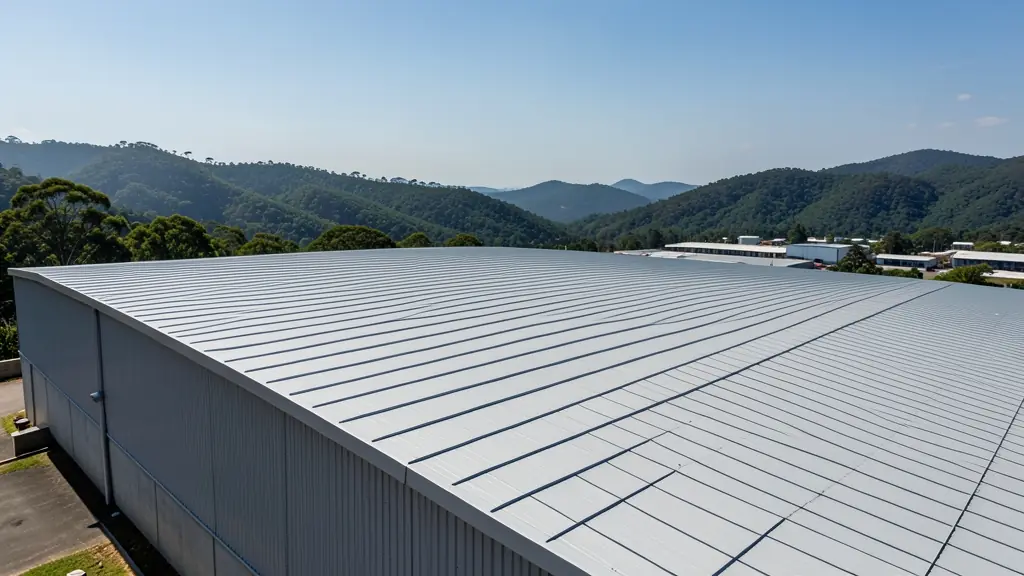
Klip lock roof sheeting, also spelt clip lock or klip lok, is the common name for concealed fix sheeting: clips are screwed to the purlins and the sheet snaps down over them, so no screw goes through the sheet. Strictly, Klip-Lok is one maker's trade name; builders here say it for any clipped sheet, and other roll formers sell the same kind of profile under names of their own. With no holes in the pans, it can run on a very low pitch and in long single lengths on warehouses, schools and modern flat looking houses.
How the clips work
A row of clips goes along each purlin. The sheet's ribs are pushed down until they lock over the clip heads, and the next sheet's edge rib locks over the last one. Nothing pierces the weather side of the roof, so there are no washers to perish and no screw holes to rust. The clips must be the type made for that profile, sheet thickness and purlin spacing: the maker's data sheet sets all three. Wrong clips are the usual reason a concealed fix roof lifts in a storm.
Low pitch and long sheets
Concealed fix profiles have tall ribs and go to the lowest pitches of any steel sheet, which is why a roofer in Nelspruit will quote one for a 2 degree warehouse where IBR would back up. Runs far longer than a truck load of IBR can be rolled in one piece, often on site, with no end laps to leak. Long sheets grow and shrink with the sun, so the clips let them slide. A sheet screwed through at the wrong place cannot move and tears at the clips over a few summers.
Walking on it, and who should fit it
- Walk on the pans near a purlin, never on the ribs, or the lock can pop open.
- Solar installers need to use clamps made for the rib, not screws drilled through it.
- Fitting takes a roofer who has done concealed fix before: setting out the first sheet square matters more than on IBR. See roof sheeting installation.
Cost against IBR
Concealed fix sheeting usually costs more a metre than IBR and covers a narrower strip, about 700 mm for the common profile and about 406 mm for narrow ones, so you need more metres for the same roof. The clips add to it, but the screws through the sheet go away. Work out the sheets on the roof sheet calculator and check the purlins on the purlin spacing calculator.
What to put in your request
- Give the pitch, even if it is only a few degrees
- Give the eave length and the full run length
- Say the purlin type and spacing, if known
- Ask for clips and fillers to be listed
- Say if solar panels will go on the roof
Klip-Lok Roof Sheeting: who asks for them and why
- Homeowners and DIY builders: a modern house with a low pitch behind a parapet and no screw heads on show
- Roofers and roofing contractors: warehouse and school jobs where long runs and clip setting out need a practised crew
- Builders, developers and quantity surveyors: low pitch roofs on new commercial shells, specified with the clips and purlins together
- Factories, warehouses and steel buildings: factories and distribution centres with long one piece runs and few laps to leak
- Shops, offices and business premises: shopping centre and office roofs hidden behind parapets at very low pitches
- Farms: sheds, barns and animal houses: large packsheds and cold store buildings where a low roof keeps the walls short
- Schools, churches, clinics and halls: school, clinic and sports hall roofs with long spans and no holes through the sheets
- Landlords, body corporates and estate managers: complex roofs behind parapets where screw leaks have been a repeat maintenance cost