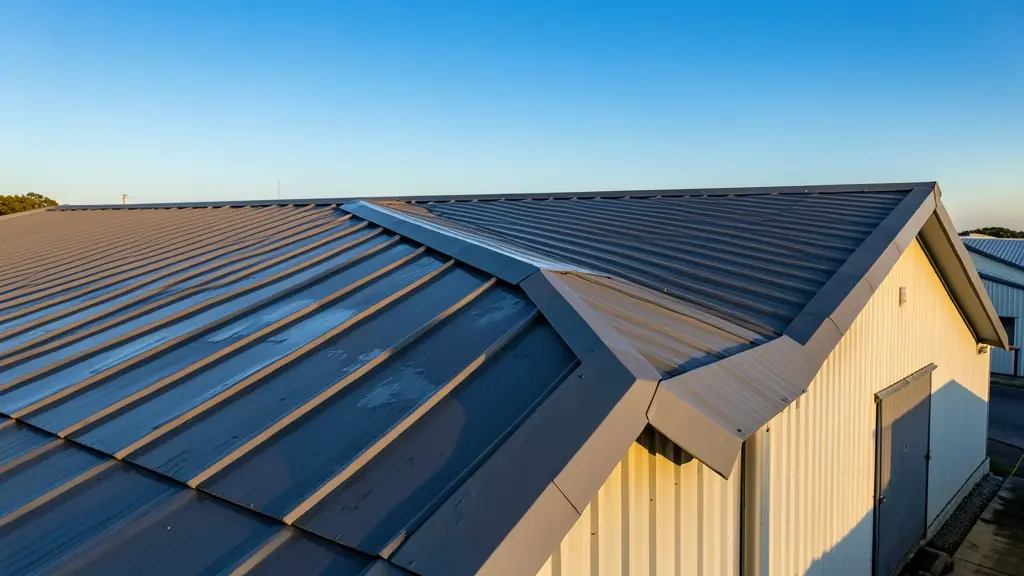
A roof flashing is the folded strip of coated steel that closes every edge and joint a sheet cannot cover by itself: the ridge where two slopes meet, the barge where the roof stops at a gable, the apron where a lean to meets a wall, the valley where two slopes run into an inside corner. Sheets seldom leak in the middle of a pan. A roofer chasing drips after a February storm looks at a capping, a wall joint or a valley first.
Types of roof flashing and where each goes
- Ridge capping sits over the top of two slopes.
- Hip capping does the same job down the sloping hips of a four sided roof.
- Barge or verge flashing wraps the gable edge, over the last rib and down past the barge board.
- Apron flashing runs across a wall where the top of a lean to slope meets it, its upper leg tucked into a chase or under a counter flashing.
- Side wall flashing follows a wall that runs down the slope beside the sheets.
- Valley gutters carry the water of two slopes at once, so they take more rain than any other part of the roof.
IBR flashings are folded to the rib
An IBR roof needs flashings shaped to its profile, not flat strips bent on site. An IBR barge laps over a full rib; an apron needs a notched edge or foam fillers so a north wester cannot drive rain up the pans and under it. Under the ridge, the ends of the pans are turned up with a turn up tool so water cannot blow back over the top of the sheet. Order the flashings in the same coating and colour as the sheets: a plain galvanised capping on an aluminium zinc roof, or a lead strip against it, starts corrosion where the metals touch.
Ordering flashings by the metre
Flashings are sold per metre or per stock length of a few metres, or folded to order on a press brake from flat coil to the girth and angles you give. Measure and list each run and shape separately and allow for a lap at every joint, laid so the upper piece covers the lower one, then riveted and sealed. The planner on the request form counts the pieces for you, and the roof sheet calculator gives a gable's ridge length.
Where leaks start and how a flashing is replaced
The usual culprits: an apron only sealed to the plaster with no chase, so the sealant cracked after two summers; a barge screwed through its face instead of on top; no fillers under a capping on a windy ridge near Gqeberha; a valley too narrow for the slope feeding it; drill filings left on a new capping that rusted orange in a week. Replacing a flashing is usually far smaller than a reroof: the old piece comes off, new fillers and fasteners go in and a matching length goes on. See also roof sheeting installation and roofing screws.
What to put in your request
- List each run: ridge, hips, barges, aprons, valleys
- Give the sheet profile and its colour or coating
- Say whether the old flashings come off first
- Mention any wall where an apron or side flashing goes
- Add a photo of the leak or the rusted capping
Roof Flashings: who asks for them and why
- Homeowners and DIY builders: a new ridge and barges on a reroof, or an apron where a patio roof meets the house
- Roofers and roofing contractors: cappings, barges and fillers folded to the profile and colour of the sheets on the job
- Builders, developers and quantity surveyors: every flashing on a new house roof listed by shape and length before the sheets arrive
- Factories, warehouses and steel buildings: long ridges, valleys and wall flashings on a factory where one leak stops a production line
- Shops, offices and business premises: aprons and side flashings where a shop canopy or carport roof meets a brick wall
- Farms: sheds, barns and animal houses: replacement ridge capping on a shed where the old one rusted and lifted in the wind
- Schools, churches, clinics and halls: leaking valleys and parapet flashings on a school hall or a church roof traced and replaced
- Landlords, body corporates and estate managers: matching cappings and barges across a complex so every unit's roof edge looks the same
Frequently asked questions
Is ridge capping the same thing as a flashing?
Can I fix a leaking flashing with sealant instead?
Do the flashings have to match the colour of the sheets?
Who will quote me, and do you make flashings?
Work it out first
- Roof sheet calculatorEave length, slope and profile in, sheets, cut lengths and running metres out
- Roofing screw calculatorSheets, purlins and fixing pattern in: main screws, stitching screws and boxes out
- Roof sheeting cost estimatorSheets, flashings, screws and labour in, a rough rand budget from published prices out